

Why are specialized pipe guides critical for maintaining continuous cooling in data centers?
In data centers, every second of downtime translates directly into lost revenue. While much attention is rightly paid to power supply, network redundancy, and server technology, one often-overlooked yet utterly critical component for continuous operation lies within the HVAC (Heating, Ventilation, and Air Conditioning) infrastructure: the indispensable pipe guide.
Data centers are hot. Very hot. Rows upon rows of servers generate enormous amounts of heat that must be continuously dissipated, primarily through chilled water or refrigerant lines. These hydronic piping systems are under constant thermal stress, cycling through temperature changes that cause pipes to expand and contract. Without precise management of this movement, through pipe guides, your entire system is at risk.
Table of Water Systems in Data Centers:
System Type |
Purpose |
Common Piping Materials |
Key Challenges/Design Considerations |
Supports & Expansion Needs |
Chilled Water Systems |
Circulates chilled water from central chillers or cooling towers to CRAHs or in-row cooling units. |
Carbon steel, copper, HDPE (underground) |
Thermal expansion, condensation control, and flow balancing |
Expansion joints, spring supports, guides to manage thermal movement & vibration |
Condenser Water Systems |
Transfers heat from chillers to cooling towers in water-cooled setups. |
Carbon steel, stainless steel |
Outdoor exposure, large diameters, thermal cycling |
Anchors and flexible joints to manage thermal growth & structural movement |
Technical / Process Water Systems |
Supports auxiliary cooling, humidification, and process functions for IT equipment. |
Stainless steel, PEX |
Cleanliness, corrosion resistance |
Insulated supports; smaller diameters, but still require thermal isolation |
Glycol / Chilled-Water Mix Systems |
Prevents freezing; used in direct-to-chip or rear-door cooling loops. |
Copper, stainless steel, PEX |
Chemical compatibility, temperature range |
Similar to chilled water systems, attention to the glycol mix impacts |
Liquid Cooling / Direct-to-Chip Loops |
Circulates coolant directly to chips or servers for high-density cooling. |
Stainless steel, PEX, reinforced polymer tubing |
Precision flow control, equipment interface sensitivity |
Highly engineered supports, vibration isolation, and precise alignment |
Make-Up Water & Drain Systems |
Supplies and removes water for cooling towers and thermal storage. |
PVC, carbon steel, stainless steel |
Varies by pressure and chemistry |
U-loops, flexible connectors near pumps & tanks |
Why do standard pipe supports fall short in high-precision data center environments?
Traditional pipe supports, while effective in many industrial applications, often lack the nuanced engineering required for the extreme demands of a data center. Imagine a long run of chilled water piping. As cold water flows through it, the pipe contracts. When the system is offline for maintenance or experiences a load change, the pipe warms up and expands. In modern high-density environments, these lines often feed into chilled distribution units (CDUs), which require perfectly stable pressure and alignment. This constant thermal movement, if not controlled, can lead to:
- Excessive Stress on Connections: Flanges, welds, and fittings are the weakest points in a piping system. Uncontrolled pipe movement can exert immense bending moments and shear forces on these connections, leading to fatigue, leaks, and eventually, catastrophic failure.
- Misalignment of Equipment: Pumps, chillers, and heat exchangers are precision machinery. If the attached piping pulls or pushes against their nozzles due to uncontrolled expansion, it can cause misalignment, bearing wear, and premature equipment failure.
- Pipe “Walking” Off Supports: In severe cases, uncontrolled lateral movement can cause pipes to “walk” off their supports, leading to complete system collapse.
- Abrasion and Wear: Pipes rubbing against rigid, unguided supports can experience wear and tear on their outer surface, compromising their integrity over time.
This is where precision-engineered pipe guides become not just beneficial, but essential.
The Role of Pipe Guides: Guiding Movement, Preventing Failure
A pipe guide is designed to control the direction of a pipe’s thermal movement, allowing it to expand and contract axially (along its length) while preventing unwanted lateral (side-to-side) or vertical displacement. This level of control is especially vital for lines carrying technical water, where even minor leaks can jeopardize sensitive IT assets.
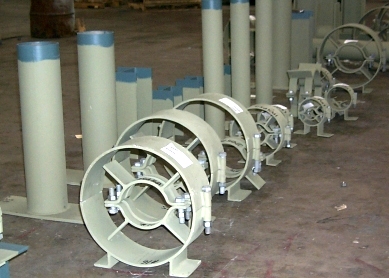
Here’s how they ensure data center HVAC uptime:
- Directed Thermal Movement: Guides funnel the pipe’s expansion and contraction into a predictable path. This ensures that the primary movement is absorbed by expansion joints, loops, or bellows designed for this purpose, rather than transferring the load caused by the movement into the connections of the equipment attached to the piping.
- Reduced Stress on Critical Components: By controlling movement, guides drastically reduce the bending moments and shear forces on pumps, valves, and other sensitive equipment connections, extending their lifespan and preventing leaks.
- Enhanced System Stability: They keep pipes securely positioned on their support structures, even during thermal cycles, minor seismic events, or operational vibrations, preventing displacement.
- Protection of Insulation: Many pipe guides are designed to accommodate and protect the pipe insulation, ensuring thermal efficiency and preventing condensation on cold lines. Often, these supports incorporate a PTFE (polytetrafluoroethylene) slide plate—a low-friction material that allows the pipe (or its insulation shield) to glide smoothly, minimizing wear and reducing the force required to move it.
Piping Technology and Products: Your Partner in HVAC Performance for Data Centers
At Piping Technology, we understand that “good enough” is never actually good enough for data center infrastructure. We specialize in designing and manufacturing custom, high-precision pipe supports and guides engineered to your cooling systems’ exact specifications. Our solutions not only meet but exceed industry standards, providing the control necessary to manage thermal stresses and virtually eliminate the risks of pipe-related downtime. We transform potential points of failure into reliable, long-lasting assets.
Is your cooling infrastructure protected from thermal stress? Don’t leave your data center’s uptime to chance. Contact our team for a comprehensive pipe stress analysis and custom-engineered pipe guide solutions designed for maximum reliability.