
By Dr. Hyder Husain Ph.D.
Dec. 2, 2010
When designing piping systems subject to thermal expansion, selecting the correct spring support is critical for maintaining structural integrity. Engineers must often choose between a variable spring support (commonly called a spring can) and a constant support.
The primary difference between a constant and a variable assembly lies in how they handle load variations as the pipe moves. While a variable spring support changes its supporting force as the internal coil compresses or extends, a constant spring uses specialized geometry to maintain a nearly uniform supporting force throughout the entire range of vertical travel. Understanding these operational differences is essential to prevent excessive loads, equipment misalignment, and stress within the piping system and connected components.
What is the difference between a variable & a constant spring support? In a variable support, the force acting on the spring and hence the reactive force varies during the pipe travel, while the moment about the line of action is zero. In contrast, in a constant support, the fixed applied load remains uniform throughout its travel but the moment around a pivot point varies.
What is a variable support? A variable support is essentially a spring, or series of springs, in a container. When the installed load “w” is applied, the spring is compressed through the distance W/k (where k is the spring rate) such that the reactive force exerted by the spring is also “w” under the equilibrium condition. As the pipe moves due to thermal expansion, it produces a deflection (∆L), causing a differential load (∆W=k ● ∆L), to act on the spring(s). Depending upon the direction of the movement, the change in load (∆W) will either add to or subtract from our installed load “w” to reach our final operating load (w1). In order to minimize the stress variations, the differential load (∆W) for a given variable spring support is limited to a maximum of 25% percent of the operating load (w1).
What is a constant support? A constant support is a device comprised of a spring or series of springs and an integral cam mechanism. The external load of a constant support is fixed while its moment about the fixed pivot point varies during its travel (because the moment arm length changes).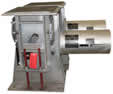 In order to maintain an equilibrium condition, the external force moment is balanced by the internal moment produced due to the spring’s compression or decompression about the pivot during the displacement of the pipe.
With an appropriate choice of moment arms, as developed by the cam geometry, and spring properties (i.e. spring rate), a resisting force can be provided that is nearly independent of position during its travel.
At each travel location of the applied load, the moment caused by the external load is balanced by the counter moment produced by the (compressed/decompressed) spring force with the appropriate moment arm. Typically, the variation of the active and reactive forces is very small (with a maximum deviation of 6%) and can be taken as a constant force while moving either upward or downward.
FAQs
Q: What is the main difference between a constant and a variable spring support?
A: The main difference between a constant and a variable support is load variation. A variable spring support changes its supporting force as the pipe moves up or down, whereas a constant spring maintains a consistent supporting load throughout the entire movement range.
Q: When should an engineer specify a constant support over a variable one?
A: A constant support is typically required when the vertical movement of the piping is significant (usually exceeding 1/2 inch) or when the pipe is connected to sensitive rotating equipment, like turbines or pumps, where load transfers could cause severe misalignment or operational issues.
Q: How does a variable spring support function in a piping system?
A: A variable spring support, commonly known as a spring can, uses a heavy-duty coiled spring to accommodate vertical thermal expansion. As the pipe moves upward or downward due to thermal expansion or contraction, the spring compresses or extends, causing the supporting force to change in proportion to the movement.
Q: Is a constant spring more expensive than a variable spring can?
A: Yes. Constant spring supports incorporate a more complex mechanical system—typically consisting of cams, levers, and springs—to maintain a nearly constant supporting force throughout the movement range. and physically larger than a standard spring.
Q: Can a standard spring support safely handle extremely high-temperature piping?
A: Yes, a highly engineered spring support can be used in elevated temperature applications. However, the spring can or constant support must be appropriately insulated, placed below the hot pipe, or positioned to protect the internal spring coils from heat-induced fatigue.
Q: How do I calculate which spring support is right for my facility’s piping system?
A: To determine the correct spring support, you must calculate the total operating load and the maximum vertical thermal movement. If the calculated load variation exceeds 25% during the pipe’s movement, industry practice generally recommends specifying a constant spring support to maintain stable load conditions and ensure safe system operation.