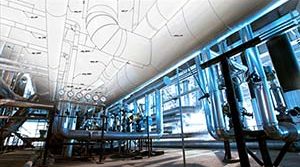
The Shift to Liquid Cooling: Powering High-Density Data Centers for the AI Era
As artificial intelligence (AI) and machine learning (ML) move from niche research projects to the backbone of global enterprise, the data center is facing a thermal crisis. Traditional air cooling, once the industry standard, is reaching its physical limits. Standard racks that previously pulled 10kW to 15kW are being replaced by high-density GPU clusters demanding 50kW, 100kW, or more. To manage this heat flux, the industry is making a decisive shift toward liquid cooling—a medium roughly 3,000 times more effective at heat transfer than air.
Engineering Reliable Piping Systems in Data Center Cooling Systems
The transition to liquid cooling is not a one-size-fits-all migration. It involves sophisticated piping networks that must deliver coolant with surgical precision. Whether a data center facility is being retrofitted or built from the ground up, understanding the three primary cooling methods—and the mechanical infrastructure required to support them—is important for operational reliability.
1. Direct-to-Chip (Cold Plate) Cooling
Direct-to-chip cooling involves circulating coolant through a cold plate sitting directly on the CPU or GPU. This method captures up to 80% of server heat, enabling extreme rack densities while using existing room-level air cooling for the remaining components.
- The Piping Requirement: High vibration resistance and leakproof integrity.
- Piping Technology Solution: Custom Engineered Expansion Joints.
- The Value: In a direct-to-chip setup, the thermal expansion of the secondary loop piping can put immense stress on delicate manifold connections. US Bellows (a PT&P company) provides precision-engineered expansion joints that absorb thermal expansion and mechanical vibration, preventing stress from being transmitted to server racks or sensitive fluid connectors.
2. Immersion Cooling (Single and Two-Phase)
In immersion cooling, servers are completely submerged in a thermally conductive, dielectric fluid. This eliminates the need for fans and allows for the highest power densities available today, as the fluid makes contact with every heat-generating component.
- The Piping Requirement: Compatibility with dielectric fluids and heavy-load structural support.
- Piping Technology Solution: Constant and Variable Spring Hangers.
- The Value: Immersion tanks are incredibly heavy when filled with dielectric fluid. The external piping delivering coolant to these tanks must be perfectly supported to prevent nozzle loading. PT&P’s constant- and variable-spring hangers ensure that, as the system reaches operating temperature, the weight of the piping remains balanced, protecting the integrity of the immersion tanks.
3. Rear-Door Heat Exchangers (RDHx)
An RDHx is a specialized radiator attached to the back of a server rack. Liquid circulates through the door, cooling the exhaust air before it ever enters the data center floor, often allowing for “chilled water-free” operation in certain climates.
- The Piping Requirement: Precision routing and flexible support in tight spaces.
- Piping Technology Solution: Pre-Insulated Pipe Supports (Hot/Cold Shoes).
- The Value: To maintain efficiency and prevent condensation in the white space (main operational area where IT gear sits), coolant lines must be adequately insulated. PT&P’s pre-insulated cold shoes provide a thermal break between the piping and the support structure. This prevents energy loss and eliminates the risk of sweating pipes, which can be catastrophic near high-voltage server equipment.
Why Liquid Cooling is the Ultimate High-Density Solution
The shift to liquid cooling isn’t just about managing heat; it’s about Total Cost of Ownership (TCO) and sustainability within the modern data center.
- Energy Efficiency: Liquid cooling reduces the Power Usage Effectiveness (PUE) by significantly lowering the energy required for fans and CRAC units.
- Performance: By keeping GPUs at a lower, stable temperature, data centers can prevent thermal throttling, ensuring AI workloads run at peak performance.
- Space Optimization: Higher density means more computing power in a smaller physical footprint, deferring the need for costly facility expansions.
PT&P Is Your Partner in Data Center Infrastructure
At Piping Technology and Products, we recognize that a data center’s liquid cooling loop is only as reliable as its weakest support or joint. We position ourselves as the ideal partner for data center operators by offering a unified engineering approach. By manufacturing both the supports that hold the system and the expansion joints that give it flexibility, we provide a holistic mechanical solution that withstands the 24/7/365 demands of critical infrastructure. Our expertise ensures a seamless, safe transition to high-density AI cooling.
Scale Your Data Center Capacity and Optimize for High-Performance Computing
If you are designing a new build or retrofitting an existing center for high-density racks, our engineers are ready to help you optimize your piping support and flexibility: schedule time with one of our engineers to discuss your long-term liquid-cooling strategy.