This project highlights the application of custom-engineered sway braces to mitigate hazardous vibrations in a pipeline entering a containment shelter. Controlling movement at this critical interface is essential to preserving the integrity of the shelter’s seal and preventing structural fatigue.
To address this challenge, sway-bracing assemblies that absorb energy and resist system oscillation were fabricated. These devices function as effective adjustable pipe braces, allowing installers to make precise field adjustments to accommodate the exact installation geometry. By using a robust sway brace design, the facility effectively dampened dynamic forces, maintaining a neutral position for the piping and protecting the containment zone from resonance-induced damage.
PT&P manufactured fig. 550B sway braces for preventing excessive loading on 12″ diameter flanged expansion joints leading into a containment shelter. The sway braces include our fig. 30 forged turnbuckles, spring casing. and size 3 spring coils along with other internal components. They are fabricated from carbon steel, hot-dipped galvanized, and designed for a spring rate of 450 lb./in. These sway braces measure 91-3/8″ pin-to-pin and are suitable for full deflection forces from 200 to 1,800 lb. Initial pre-compressed spring forces are from 50 lb. to 450 lb. to dampen vibrations, oppose pipe sway and absorb shock forces.
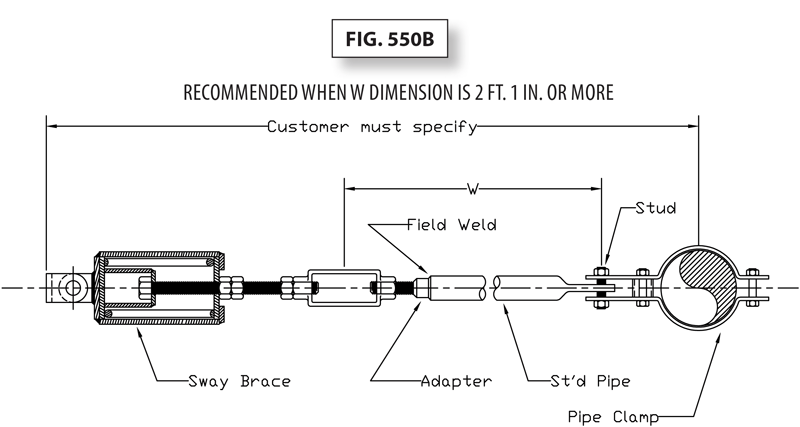
Sway braces are recommended for controlling vibration, absorbing shock loadings; guiding or restraining the movement of the pipe resulting from thermal expansion; bracing a pipeline against sway. The vibration control and sway brace is shipped and ready for installation. The rod coupling rotates with slight resistance and the tension test collar can be rotated by hand while holding the rod stationary.
The sway brace should be in the neutral position when the system is hot and operating, at which time the tension test collar should be hand tight. If it is not, the sway brace should be adjusted to the neutral position by use of the load coupling. The screws in the tension test collar need not be loosened, since they serve only to secure it to the load coupling.
Frequently Asked Questions:
Q: What is the primary function of sway braces in this application?
A: The primary function of sway braces in this application is to control vibration and restrain the pipe from lateral or swaying movement. They provide a restoring force that resists displacement, helping maintain the pipe in a stable, neutral position as it enters the containment shelter.
Q: Why were adjustable pipe braces specified for this project?
A: Adjustable pipe braces were specified to accommodate field tolerances and ensure precise alignment during installation. The turnbuckle or threaded adjustment mechanism allows installers to fine-tune the brace length to match the exact distance between the pipe and the structural attachment point.
Q: How does sway bracing differ from a rigid strut?
A: Unlike a rigid strut, which locks the pipe in a fixed position, sway bracing incorporates a spring mechanism that allows limited controlled movement. This design helps absorb and dampen vibration while still providing restraint. In contrast, a rigid strut transfers dynamic loads directly to the structure, increasing stress and the potential for structural damage.
Q: Can a single sway brace handle both tension and compression loads?
A: Yes. A properly designed sway brace can exert a restoring force in both tension (pulling) and compression (pushing). This dual-action capability is essential for stabilizing piping systems subject to oscillation, helping control movement in either direction and maintain system stability.
Q: Why is vibration control critical for pipes entering a containment shelter?
A: Unchecked vibration can compromise the seal where the pipe passes through the shelter wall. Implementing effective sway bracing minimizes movement at the penetration point, preserving the airtight or safety seal of the containment structure.
Q: Does the sway brace accommodate thermal expansion?
A: Yes, to a degree. While the primary purpose is vibration damping, the spring element in the sway brace allows limited thermal movement without locking the system, provided the travel does not exceed the spring’s operating range.
Q: How are these sway braces sized for the application?
A: The size of the sway brace is determined by the magnitude of the vibration forces and the weight of the piping system. Engineers calculate the required spring rate and load capacity to ensure the brace can effectively counteract dynamic forces.
Q: Is maintenance required for sway bracing assemblies?
A: Yes. Routine inspection of sway bracing is recommended to ensure the springs remain within their proper load indicators and that the adjustable pipe braces have not loosened due to continuous vibration over time.