Designing a chemical plant is a monumental undertaking that requires rigorous planning, detailed engineering, and the careful selection of every component, especially the piping products that are the very lifeblood of the facility. The successful execution of a new plant relies on a structured, multi-phase process that minimizes risk, optimizes efficiency, and ensures safety and compliance. This blog post explores the key stages of chemical plant design and highlights the crucial role of different piping products in bringing these complex industrial visions to life.
The Foundation of Design: Essential Project Phases
The design process for a modern chemical plant typically comprises several phases, from conceptualization to final construction. This structured approach, known as Front-End Engineering Design (FEED) or, more broadly, the Project Management Process, ensures that technical viability and financial feasibility are confirmed before committing to large capital expenditures.
Step 1: The Block Flow Diagram (BFD)
The very first step in visualizing a plant is creating the Block Flow Diagram (BFD).
This is the simplest representation of the process. It uses blocks (rectangles) to represent major equipment, operations, or process areas (e.g., Reactor, Separator, Storage Tank). Arrows indicate the general flow of materials between these blocks. The BFD focuses on the overall process scheme, material balance, and energy integration without worrying about specific mechanical details or exact piping runs. It’s a crucial early communication tool for the entire team.
Step 2: Process and Instrumentation Diagram (P&ID)
Once the BFD is approved, the design evolves into the Process and Instrumentation Diagram (P&ID). This is arguably the most crucial engineering drawing in the entire plant design process.
The P&ID provides a detailed, schematic representation of the process equipment, piping, instrumentation, and control systems. Unlike the BFD, the P&ID includes every pipe run, valve, instrument, and control loop. It shows:
- All major and minor equipment (pumps, vessels, heat exchangers).
- The complete piping network, showing lines, sizes, and specifications.
- Instrumentation (sensors, transmitters, controllers, and final control elements like control valves).
- Safety systems (relief valves, rupture discs).
Engineers use the P&ID to verify the design’s operability, safety features, and compliance with regulations. It serves as the baseline document for all subsequent detailed engineering and procurement activities.
Step 3: The Front-End Loading Team (FEL)
While not a physical drawing, the Front-End Loading (FEL) process, also sometimes called Front-End Engineering Design (FEED), is a critical organizational phase. The FEL team is an interdisciplinary group of engineers, project managers, and financial analysts responsible for defining the project scope, evaluating technical risks, estimating costs, and establishing a detailed project execution plan.
The goal of the FEL team is to “front-load” the project with sufficient detail and analysis so that the final estimated cost is highly reliable. Successful FEL completion drastically reduces the risk of costly changes and delays during the later construction phases. The P&ID and preliminary equipment specifications are key outputs of the FEL phase.
Step 4: Geometric Model (3D Model)
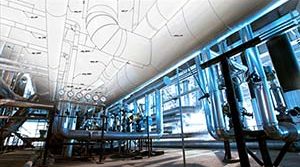
The final stage of visualization involves creating the Geometric Model: the complete 3D model of the entire plant. Using specialized computer-aided design (CAD) software, engineers model the exact spatial relationship of every piece of equipment, structural steel, electrical conduit, and, most importantly, the piping. The 3D model is essential for:
- Clash Detection: Identifying interferences where pipes, steel, or equipment physically collide before construction begins.
- Safety and Maintenance: Ensuring sufficient access for operators, maintenance personnel, and emergency response.
- Stress Analysis: Providing accurate routing data for piping stress analysis.
- Fabrication Spools: Generating highly accurate bills of material and isometric drawings for pipe fabrication.
Types of Piping Products in Chemical Plant Design
The piping network is the plant’s nervous system, and its components must withstand a wide range of pressures, temperatures, and corrosive environments. The correct selection of piping products is vital for plant longevity and safety.
1. Pipes and Tubing
The main conduits are typically made of carbon steel for utility services (like water and steam) or stainless steel (304/316) for corrosive chemical applications. Exotic alloys like Hastelloy or Inconel are reserved for highly aggressive environments. Size is determined by flow rate, and wall thickness (schedule) by pressure.
2. Pipe Fittings
These components change the direction or size of a pipe run:
- Elbows (90° and 45°): Change direction.
- Tees and Wyes: Divide the flow.
- Reducers: Change the pipe size.
- Flanges: Join pipes, equipment, and valves, allowing for easy disassembly. They come in various types, such as weld neck, slip-on, and blind flanges.
3. Valves
Valves control, divert, or stop the flow of process fluid. Their type depends entirely on the service:
- Gate Valves: Used for on/off isolation (completely open or fully closed).
- Globe Valves: Used for throttling or regulating flow.
- Ball Valves: Provide quick shut-off and are suitable for slurry service.
- Check Valves: Prevent backflow.
- Relief Valves: Essential safety devices that open automatically to relieve excess pressure.
4. Pipe Hangers and Supports
These products are critical for stress management and stability. They carry the entire weight of the pipe, fluid, and insulation while also managing movement due to thermal expansion and vibration. Products include:
- Rigid Supports: U-bolts, saddle supports, and anchor points.
- Adjustable Supports: Threaded rods and clevis hangers.
- Engineered Supports: Spring hangers or constant effort supports that are specifically designed to absorb significant vertical movement while maintaining a steady force on the pipe, crucial near sensitive equipment like pumps or turbines.
Key Tools in Modern Plant Design

The efficiency of modern plant design is mainly due to advanced software tools. The shift from 2D drafting to 3D modeling has revolutionized the industry.
- P&ID Software: Programs such as AutoCAD P&ID and SmartPlant P&ID enable engineers to rapidly create intelligent, data-rich schematic diagrams that link directly to equipment databases.
- 3D Modeling Suites (CAD): Tools such as AVEVA E3D (Everything3D) and SmartPlant 3D are used to create the detailed geometric model. These platforms are the engine of clash detection and are used to produce all fabrication drawings.
- Pipe Stress Analysis Software: Specialized tools such as CAESAR II are used to model complex piping systems mathematically. They calculate the forces and moments acting on pipes and equipment nozzles under various operating conditions (e.g., hot/cold, wind, seismic loads), ensuring the proper specification of pipe supports and preventing mechanical failure.
The Critical Role of Pipe Supports in Plant Integrity
The selection and installation of pipe hangers and supports is a frequently underestimated element of plant design. Poorly specified supports can lead to excessive equipment stress, fatigue-related pipe failure, and costly downtime. Engineers rely on sophisticated analysis to select supports that can withstand static weight, dynamic loads (such as wind and surge), and, most critically, the substantial movement caused by thermal expansion and contraction. High-quality, engineered supports are an investment in the plant’s long-term operational health and safety profile.
Piping Technology & Products: Your Partner in Engineered Support Solutions
At the center of plant design and operations is the need for specialized piping components. Piping Technology understands that standard catalog products are often insufficient for the extreme demands of chemical processing. We engineer and manufacture custom supports, expansion joints, and pulsation dampeners built to the exact specifications of your P&IDs and stress analysis reports. Our focus is on mitigating the risks associated with corrosive environments and high cyclic stresses, ensuring the lifespan of your most critical infrastructure.
Our teams provide custom-engineered pipe hangers, supports, and specialty components that improve the performance of your chemical plant. We move beyond standard practices to deliver precision-fabricated solutions that withstand extreme thermal expansion and corrosive environments. Set up time with our field survey and inspection teams, and get started with a full review of your plant’s piping infrastructure.